

Every program asks for something different. Your family needs one plan.
ArtsCompass turns each college dance program’s prescreens, requirements and audition dates into one plan for your dancer, checked against the school’s own website.
Twelve schools. Twelve sets of rules. One kitchen table.
A serious dancer applies to five to twelve programs, and each one wants something different: its own prescreen video, résumé format, photo rules, essays, and audition dates in different cities, often on a different round from the university application.
Families spend $5,000 to $12,000 on coaching, video shoots and travel. Yet the core job, knowing exactly what each school wants and whether it’s ready, still happens in a spreadsheet at midnight.

Here’s what “send us a video” means at four schools.
Candidates must submit two video auditions as a part of their USC Kaufman Portfolio by December 1.
On the two solos: “We want you to interpret the word ‘contrasting’ for yourself (and you’ll be asked to explain how they are contrasting).”
Upload a video no longer than 60 seconds introducing yourself to the Kaufman Admissions Committee and responding to the prompt below.
The prompt: “Describe a specific setback you experienced in dance that challenged how you saw yourself as an artist.”
Once the class link is opened, you will only have four (4) hours to access the teaching video to ensure you do not memorize the class.
In-person callbacks will require applicants to take ballet and contemporary class, participate in an improvisational component, perform a solo (up to two minutes in length, no pointe solos please), and have a short interview with Dance Department faculty.
Prepare a two minute dance solo demonstrating a wide range of your dance technique and artistry.
In 60 seconds or less, state your name, tell us where you’re from and outline your performing experience. Please explain why you want to attend Chapman. Be sure to use a medium shot (from chest up).
Re-creation of all three technique videos (ballet, modern, and jazz)
Plus: “Solo in your technique of choice that best showcases your abilities.”
The audition video should include: Personal introduction (one minute or less)
Two contrasting solos at USC, and you decide what “contrasting” means. A class you have four hours to learn and film at NYU. A two-minute solo at Chapman. Three technique videos to re-create at SMU. And every one wants to hear your dancer speak, in a different way.
One page that answers “what’s next?”
Add your schools and their requirements, deadlines and audition dates appear on their own, taken from each program’s website. As your dancer finishes each piece, the plan keeps count.
 1
2
3
1
2
3
 4
5
6
4
5
6
- What’s due next, across every school, soonest first, with the school’s own wording.
- How ready you are, counted from the requirements your dancer has actually finished.
- Whose turn it is: what’s waiting on you, on your dancer and on your consultant.
- School by school, everything that school asks for, what’s done and what’s missing, so nothing hides in an inbox.
- Events that can lead here: the intensives and scholarship auditions where this college recruits.
- What it costs, the sticker price and what families typically pay, next to any offer.
Audition dates are yours to pick, and a clash with another audition is flagged before you book. When a school changes a deadline or a requirement mid-season, you see the old wording next to the new, with a link to the school’s page. In the spring, each school’s decision date sits on its row, the dance department’s beside the university’s where it decides separately, and talent-award offers line up side by side. Younger dancers use the same plan for summer-intensive auditions from about age twelve, so by senior year the materials are already in place.
 1
2
3
1
2
3
- Sessions to pick from, each with its own dates and place, so the calendar holds the one your dancer will attend.
- What it costs, tuition, housing and fees, with the program’s own price lines.
- Every date to know: when applications open, when each payment is due.
The catalog holds more than 3,000 intensives, auditions and events, each read from the organizer’s own site, with sessions, prices, deadlines and what to wear.
The whole year, and what it costs
Long before college comes up, a serious dancer’s year runs on conventions, competitions and intensives. Upload the season schedule your studio already sends you, and ArtsCompass proposes each event for your calendar. You confirm every line, and the file isn’t kept.
Every trip keeps its dates, its deadlines (register by, hotel cut-off, each payment) and a running cost estimate, and events close together in the same area can share one trip and one hotel. Both parents can sign in, your dancer gets their own login from the same panel, and you keep private notes for each meeting with your consultant.
Your dancer gets their own login, on the phone they already carry.
Applying is the dancer’s work: the résumé, the essays, the videos, the interviews. ArtsCompass gives them a workspace for each piece, built from their own school list and checked against what each school asks for.
It’s made for a phone. Today’s deadlines, every school and the work still to do are a thumb away, with text and buttons sized for it, so a few minutes between class and rehearsal is enough to move the plan forward.
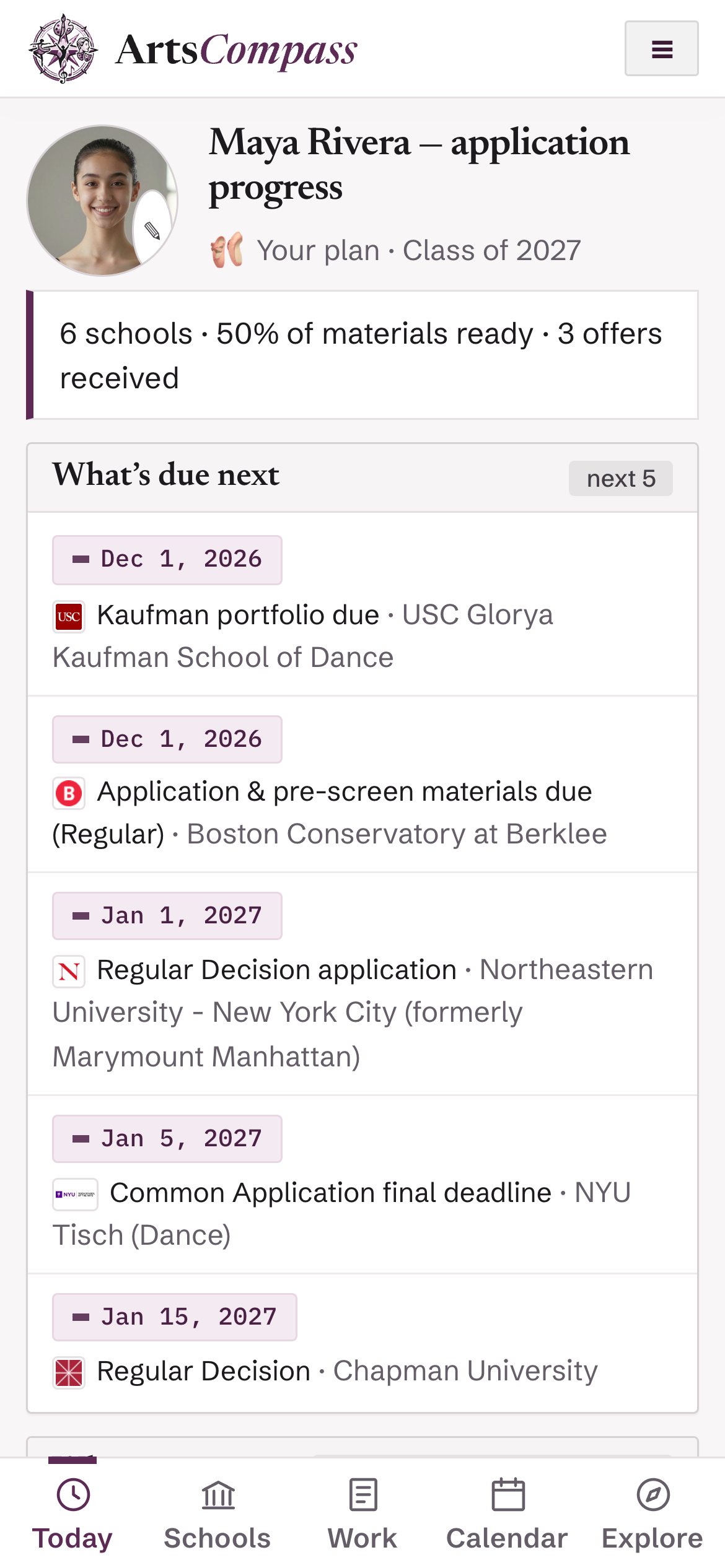
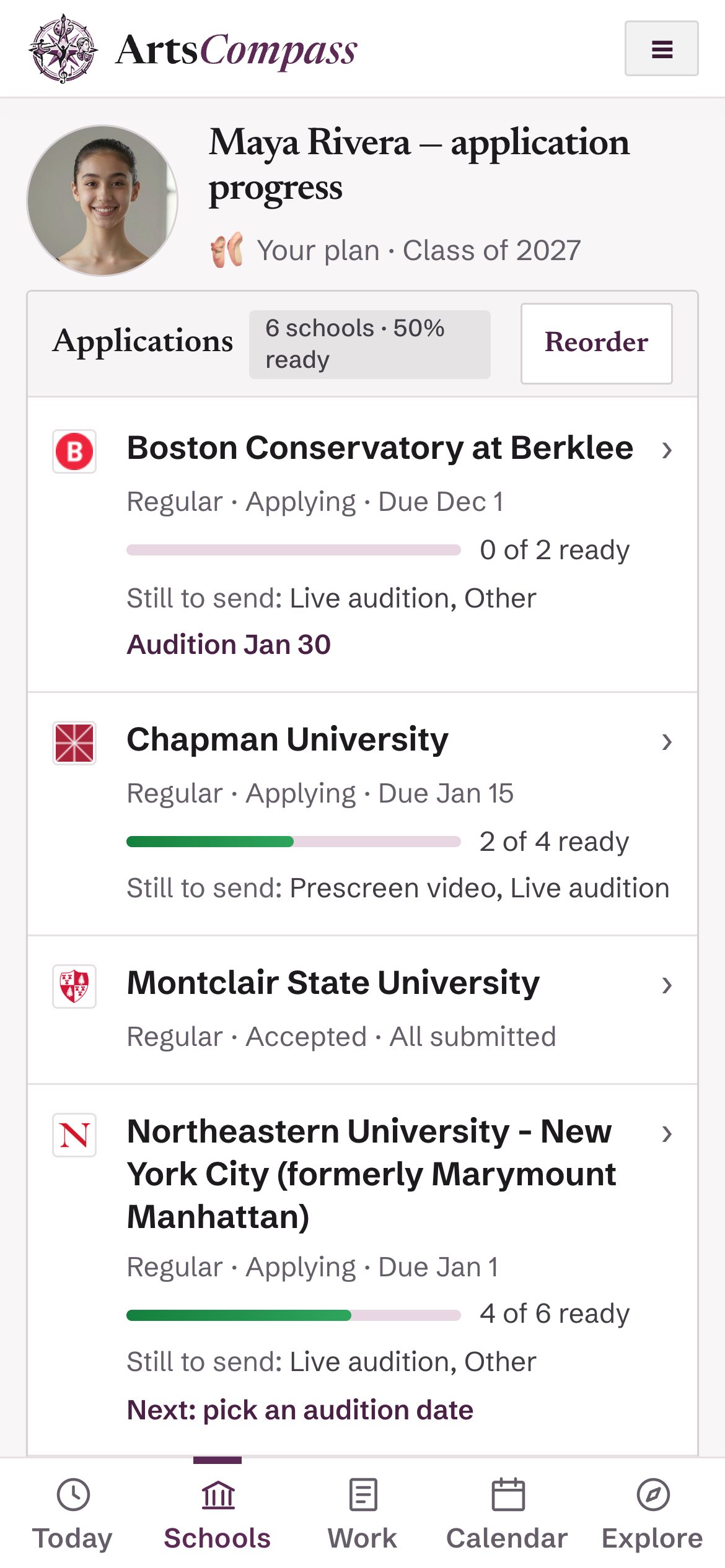
- i
Their own login
The dancer signs in to a page that puts their own work first. Parents follow the progress; the work stays the dancer’s.
- ii
A dance résumé, to each school’s rules
Built from the dancer’s training, performances and awards, with each school’s format rules alongside (USC Kaufman’s one-page template, for one).
- iii
An essay plan that builds itself
The Common App essay, each school’s own prompts and the “choose one of” groups appear as schools are added, with versions, comments and due dates.
- iv
A coach that asks, never writes
The AI coach asks questions and points at passages. It never writes or rewrites a word, because the essay has to be theirs.
- v
Video answers, rehearsed
Inside the essay plan, for every interview or spoken video prompt: the school’s exact wording, its time limit, a beat sheet of key phrases and a rehearsal timer.
- vi
Recommendation letters, tracked
Who is writing which letter, for which school, when to ask and where each one stands.
- vii
An asset library
Videos, headshots and résumés in one place. Each shows how many requirements it covers; originals stay in the family’s own Drive or Dropbox.
- viii
Drafts that stay private
Drafts are the dancer’s until they choose to share them with parents, or send a time-limited review link to a teacher.
- ix
Events they actually want
The dancer hearts the intensives and events they’d like to attend; parents decide what goes on the calendar.
- x
Questions for every visit
Questions to ask on a campus tour, at an audition or in an interview, grouped by who to ask, with room to note the answers.
The whole video brief, written for you.
Nobody types this. When your dancer adds a school, ArtsCompass reads that school’s video requirements on its own website and writes them into one brief: what to film, how long each piece runs, which takes cover which schools, what needs its own session and what every file should be called. Each direction is the school’s own wording. Change the school list and the brief rewrites itself.
 1
2
3
4
1
2
3
4
- Built from the school list: six schools become twelve numbered shots, and the brief updates the moment the list changes.
- The shoot plan: film each solo full length once, then cut each school’s version from those takes.
- For the videographer: an estimate of the shoot time and a private, read-only link to the shot list. No account needed.
- A separate session flagged where a school needs one, like NYU’s class that must be learned and filmed within four hours.
The shoot itself becomes a plan: book the videographer, settle the scripts, schedule the edit, each step with an owner and a date that moves when the shoot does. Your videographer, choreographer and coaches sit in one place with the family’s team, including any your consultant recommends.
With you from the first résumé to decision day.
Swipe to see the whole season →
Verified, not generated.
One missed prescreen deadline can cost a dancer a year. Chatbots guess at these dates. Every fact in ArtsCompass carries the school’s own sentence, a link to the page it came from, and the date we checked it, like the four above. Anything not yet confirmed shows the page it came from, so you can read it there. Nothing is ever filled in.
- i
The school’s own page
Never a third-party list or a forum.
- ii
The exact words
The school’s sentence is stored with the fact, so you can read it yourself.
- iii
Checked in code
Software confirms the sentence is really on the live page.
- iv
A second reader
An independent reader from a different AI family has to agree. If it doesn’t, a stronger reader takes a second look, and a person settles what the page can’t.
And we check the checkers. Every reader is regularly handed claims we know are false, and one that agrees with them is benched. Every month a person checks a random sample of our facts against the schools’ own pages. When a school changes its page, the new wording goes back through the same checks, and we keep every earlier version.
Today that’s 261 college dance programs, 750 requirements read from each school’s own page, 2,118 faculty, and more than 3,000 auditions, intensives and events with more than 18,000 details on them (sessions, prices, deadlines, dress codes), re-checked through the season.
Counts from the live catalog, October 2026.

Spend your hours on judgment, not on spreadsheets.
Families pay you for judgment: which programs fit, how to build the list, what an audition panel will notice. ArtsCompass takes the rest off your desk: the per-school research, the deadline tracking and the checklists.
The consultant console is free. Bring the families you work with onto ArtsCompass at a wholesale seat price and include it in your own package. Your method, your pricing, and reports issued under your own name and logo.
 1
2
3
4
5
1
2
3
4
5
- This week, across every family: who’s due, who needs you, overall readiness.
- Needs you: essays waiting for your review and audition dates waiting for your advice.
- Due in the next three weeks, by dancer and school, with how ready each one is.
- Decision points: offers, response dates and audition clashes that need a conversation.
- Gone quiet: families reading the plan but not moving it, before it becomes a problem.
Already running a practice?
Move your families in and keep your process. Each meeting starts from an agenda built off the calendar: the next deadline, what each school needs for it, and who’s doing what by when. In decision season, one list shows every school still to decide, soonest first, and the videographers and coaches you trust live in a private directory you share into a family’s team with one click.
Thinking about starting one?
If you trained seriously, auditioned and made it through, families want what you know. ArtsCompass supplies the research, the calendar and the checklists, so you can focus on guiding them.
Your seniors, and where your dancers go.
Studios already guide dancers to college, mostly by word of mouth and late nights. College Track puts every senior’s plan in one dashboard for your faculty, shows which prescreens are due and who needs help with a video or a résumé, and builds the placement record prospective families ask about on a studio tour.
Younger students use the same plan every year for summer intensives, conventions and competitions, and families load the season schedule you already send them straight into their calendars.
Run a college program or an intensive? Check your listing.
Every fact on a listing comes from the program’s own website, with the source and the date. If something is wrong or out of date, tell us and we’ll correct it. Listings are never ranked, and student data is never shared or sold.
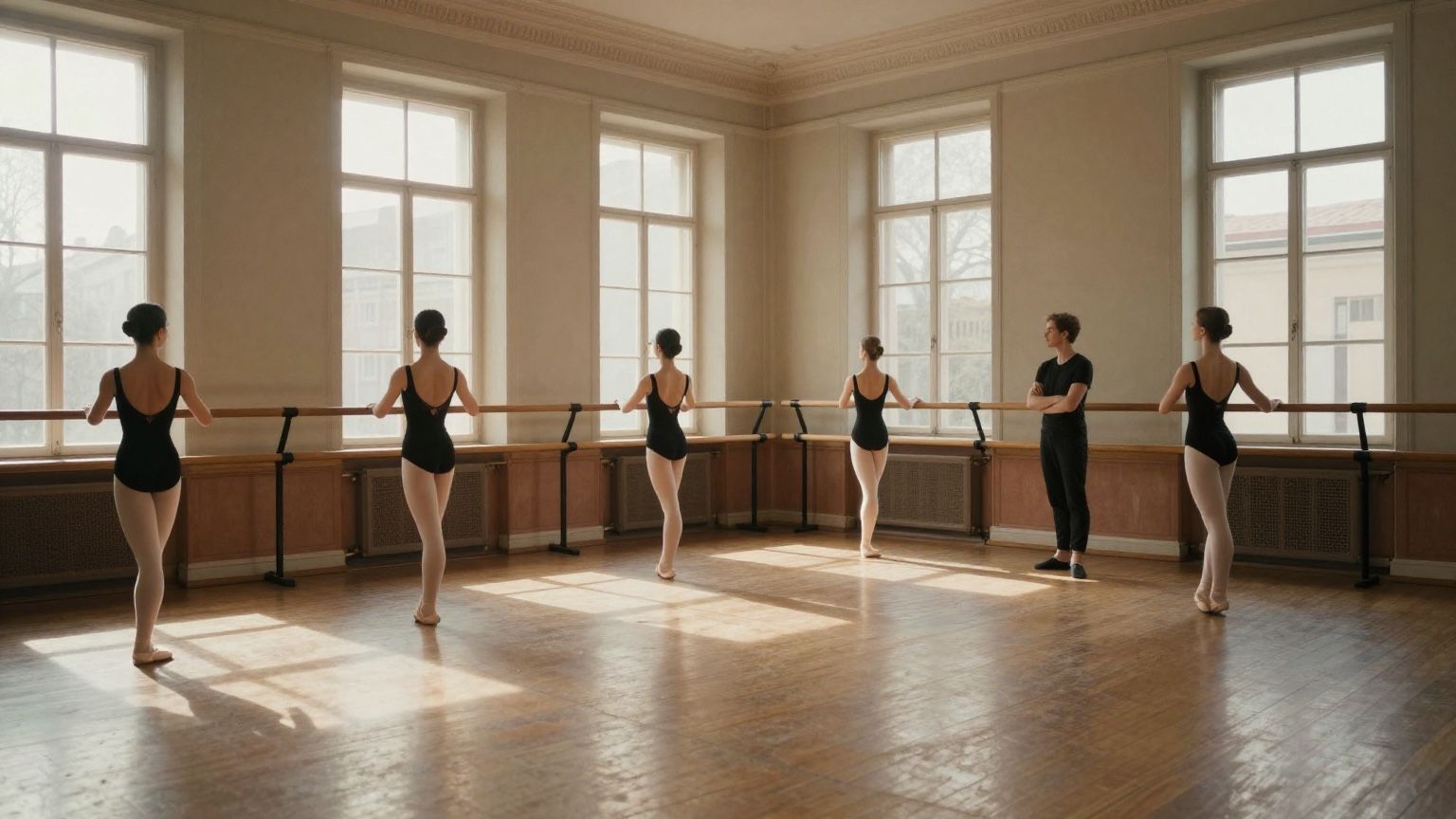
Send a correction →I’m a dance parent. When my son started applying to college dance programs, our kitchen table looked a lot like the photo above: printed requirements, a spreadsheet, sticky notes with deadlines, and a steady worry that we’d missed something. Every school wanted something slightly different, and the details kept changing under us.
I build software for a living, so I started building the tool we needed. ArtsCompass reads each program’s own website, keeps the facts current, and turns them into one plan a family can follow, with room for the consultant or teacher guiding them.
We’re starting with a small group of families and consultants. If you’d like to be one of them, I’d love to hear from you.
Chris ArcherFounder, ArtsCompass · [email protected]
We coach. We never write the essay.
The essay coach asks questions and never writes a word. The résumé assistant only suggests wording, and nothing changes until your dancer accepts it. Admissions panels can tell the difference.
Facts, with their source
Every requirement links to the school’s page and shows when we checked it. Where we aren’t sure, we say so.
Your family’s data is yours
Parents own the account. We never sell or share student data, and no school pays to change a fact or a ranking.